
Differential expression with a continuous covariate
Source:vignettes/continuous_covariate.Rmd
continuous_covariate.RmdIntroduction
This vignette demonstrates how to use the devil package
to perform differential expression (DE) analysis with continuous
covariates. Specifically, we’ll analyze how gene expression
changes over time in an experiment where the continuous variable is days
post-amputation.
Setup and Data Loading
library(devil)
library(scRNAseq)
library(SingleCellExperiment)
library(Matrix)
library(dplyr)
library(ggplot2)
library(tidyr)
library(ggpubr)

# Load axolotl tail regeneration data
# This dataset contains scRNA-seq from regenerating tail tissue at different timepoints
sce <- scRNAseq::AztekinTailData()
Data Preprocessing
Quality Filtering
We first filter out genes with very low expression to remove noise and improve computational efficiency:
counts <- assay(sce, "counts")

# Keep genes with:
# 1. Mean expression > 0.1 counts per cell
# 2. Detected in at least 100 cells
keep_genes <- rowMeans(counts) > 0.1 & rowSums(counts > 0) > 100
sce <- sce[keep_genes, ]

cat("After filtering:", nrow(sce), "genes and", ncol(sce), "cells\n")
#> After filtering: 7779 genes and 13199 cells
Subsampling for Quick Demonstration
For this vignette, we subsample the data so computations run quickly. In practice, you would use the full filtered dataset:
set.seed(123)
n_genes <- min(2000, nrow(sce))
n_cells <- min(5000, ncol(sce))

gene_idx <- sample(seq_len(nrow(sce)), n_genes)
cell_idx <- sample(seq_len(ncol(sce)), n_cells)
sce_sub <- sce[gene_idx, cell_idx]

cat("Working with:", nrow(sce_sub), "genes and", ncol(sce_sub), "cells\n")
#> Working with: 2000 genes and 5000 cells
Building the Design Matrix
Understanding the Covariate
Our main variable of interest is DaysPostAmputation, a
continuous variable representing time since amputation. Let’s examine
its distribution:
meta_df <- as.data.frame(colData(sce_sub))

# Check the range and distribution of DaysPostAmputation
cat("DaysPostAmputation range:",
    min(meta_df$DaysPostAmputation), "to",
    max(meta_df$DaysPostAmputation), "days\n")
#> DaysPostAmputation range: 0 to 3 days

table(meta_df$DaysPostAmputation)
#>
#>    0    1    2    3
#> 2004 1175  875  946
Creating the Design Matrix
For a continuous covariate, the design matrix includes: 1. An
intercept term representing baseline expression 2. A
slope term for DaysPostAmputation
representing the rate of change per day
design <- model.matrix(
  ~ DaysPostAmputation,
  data = meta_df
)

head(design, n = 10)
#>                    (Intercept) DaysPostAmputation
#> GCATACACAGCCAATT.1           1                  2
#> ATAGACCAGTGCGATG.1           1                  0
#> ATTACTCGTCTTCTCG.1           1                  1
#> GGACAAGAGAGGGCTT.1           1                  2
#> GATGCTACAGAGTGTG.1           1                  0
#> CTCTAATTCAAACAAG.1           1                  0
#> ACGTCAACAACACCTA.1           1                  3
#> TGTGGTATCTCTAGGA.1           1                  0
#> TCAGCTCCACAGGCCT.1           1                  0
#> GTCCTCAAGCGATGAC.1           1                  3
cat("\nDesign matrix columns:", colnames(design), "\n")
#>
#> Design matrix columns: (Intercept) DaysPostAmputation
cat("Design matrix dimensions:", nrow(design), "cells ×", ncol(design), "coefficients\n")
#> Design matrix dimensions: 5000 cells × 2 coefficientsInterpretation: - (Intercept): Expected
log-expression at day 0 - DaysPostAmputation: Change in
log-expression per additional day (i.e., the slope)
Fitting the devil model
First, let’s group the data based on the sample ids.
Y <- as.matrix(assay(sce_sub, "counts"))
grouped_data = devil::group_data(Y, design, meta_df$sample)
Now, fit_devil() takes a count matrix and a design
matrix and returns coefficients and overdispersions.
devil_fit <- devil::fit_devil(
  x = grouped_data$input_matrix,
  design_matrix = grouped_data$design_matrix,
  clusters = grouped_data$clusters,  # Account for sample-level correlation
  verbose = TRUE,
  init_beta_rough = FALSE,
  size_factors = "normed_sum",
  overdispersion = "MOM"
)
#> Compute size factors
#> Calculating size factors using method: normed_sum
#> Size factors calculated successfully.
#> Range: [0.1246, 9.1512]
#> ==> Initializing parameters
#> Initialize theta
#> Initialize beta
#> Fitting expression coefficients and overdispersion
#> Aggregating results
Interpreting Model Coefficients
Coefficient Matrix Structure
The fitted model contains coefficient estimates (on the log scale) for each gene and each term in the design matrix:
Visualizing Coefficient Distributions
Let’s examine the distribution of the DaysPostAmputation
coefficient across all genes:
coef_df <- as.data.frame(beta_matrix) %>%
  dplyr::mutate(gene = rownames(beta_matrix))

# Reshape for plotting
coef_long <- coef_df %>%
  tidyr::pivot_longer(cols = -gene, names_to = "coefficient", values_to = "value")

# Plot distribution of DaysPostAmputation coefficient
ggplot(coef_long %>% dplyr::filter(coefficient == "DaysPostAmputation"), aes(x = value)) +
  geom_histogram(bins = 50, fill = "steelblue", alpha = 0.7) +
  geom_vline(xintercept = 0, linetype = "dashed", color = "red", linewidth = 1) +
  theme_bw() +
  labs(
    title = "Distribution of DaysPostAmputation coefficients across genes",
    subtitle = "Positive values = upregulated over time, Negative = downregulated",
    x = "Coefficient value (log fold-change per day)",
    y = "Number of genes"
  )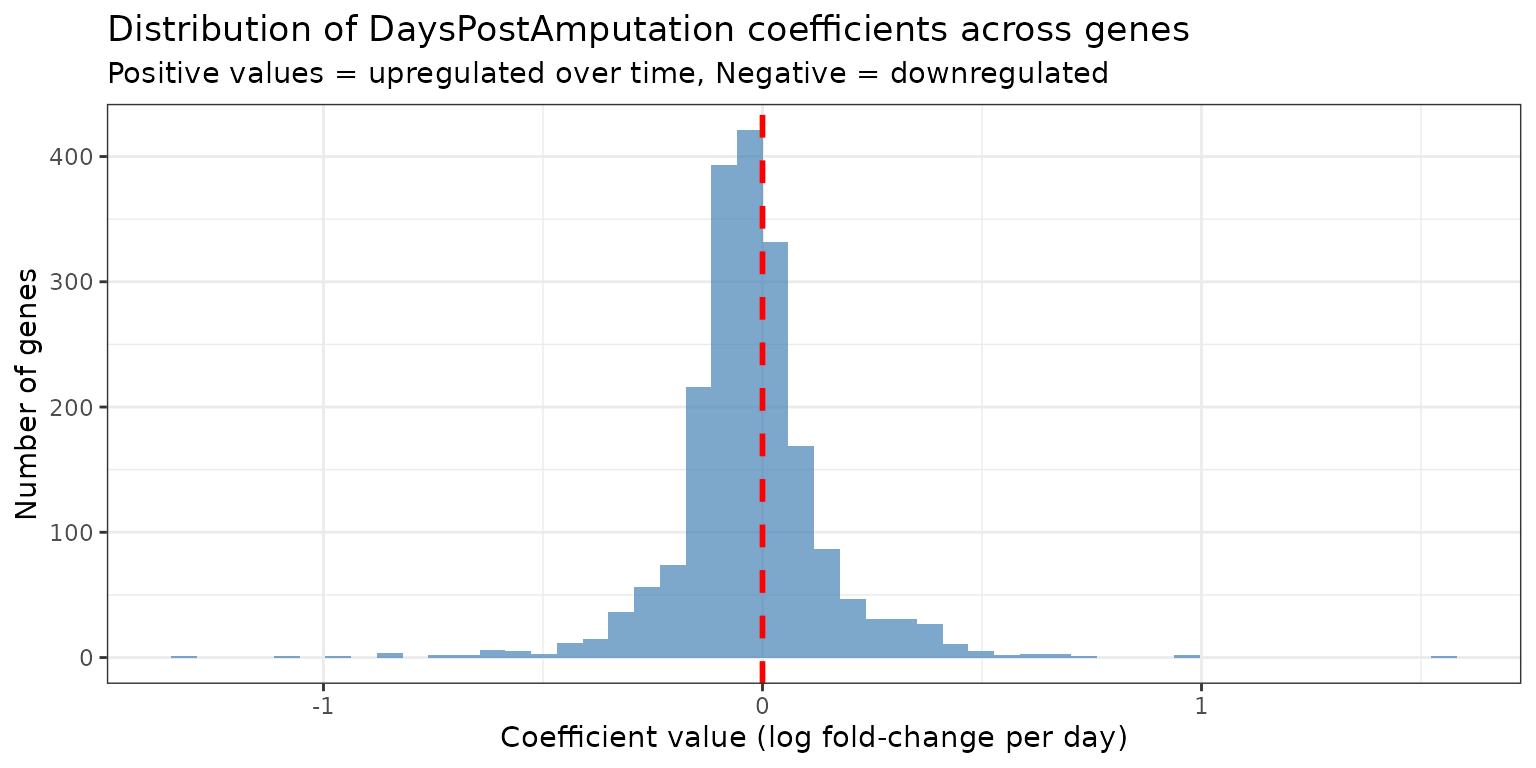
Interpretation:
- Genes with positive coefficients increase expression over time
- Genes with negative coefficients decrease expression over time
- The magnitude indicates the rate of change per day
Differential Expression Testing
Testing for Time-Dependent Expression
We use a Wald test to identify genes whose expression significantly
changes with days post-amputation. The contrast vector
c(0, 1) tests the DaysPostAmputation
coefficient (second column in design matrix):
# Contrast vector: test the DaysPostAmputation coefficient
# c(Intercept, DaysPostAmputation)
contrast_vector <- c(0, 1)

de_res <- devil::test_de(
  devil_fit,
  contrast = contrast_vector,
  max_lfc = 100
)

# Add gene names
de_res$name <- rownames(beta_matrix)

head(de_res)
#> # A tibble: 6 × 4
#>   name       pval adj_pval      lfc
#>   <chr>     <dbl>    <dbl>    <dbl>
#> 1 timm10b.S 0.633    0.960 -0.104
#> 2 nudcd2.L  0.519    0.934 -0.123
#> 3 srsf4.S   0.211    0.855 -0.100
#> 4 tmem144.L 0.397    0.929  0.173
#> 5 c1d.L     0.766    0.973  0.0523
#> 6 pop7.L    0.980    0.998 -0.00219
Summary of DE Results
# Count significant genes at FDR < 0.05
de_summary <- de_res %>%
  summarise(
    total_genes = n(),
    n_de = sum(adj_pval < 0.05),
    n_upregulated = sum(adj_pval < 0.05 & lfc > 0),
    n_downregulated = sum(adj_pval < 0.05 & lfc < 0),
    pct_de = round(100 * n_de / total_genes, 1)
  )

print(de_summary)
#> # A tibble: 1 × 5
#>   total_genes  n_de n_upregulated n_downregulated pct_de
#>         <int> <int>         <int>           <int>  <dbl>
#> 1        2000    20            10              10      1

cat("\n", de_summary$n_upregulated, "genes increase expression over time\n")
#>
#>  10 genes increase expression over time
cat(de_summary$n_downregulated, "genes decrease expression over time\n")
#> 10 genes decrease expression over time
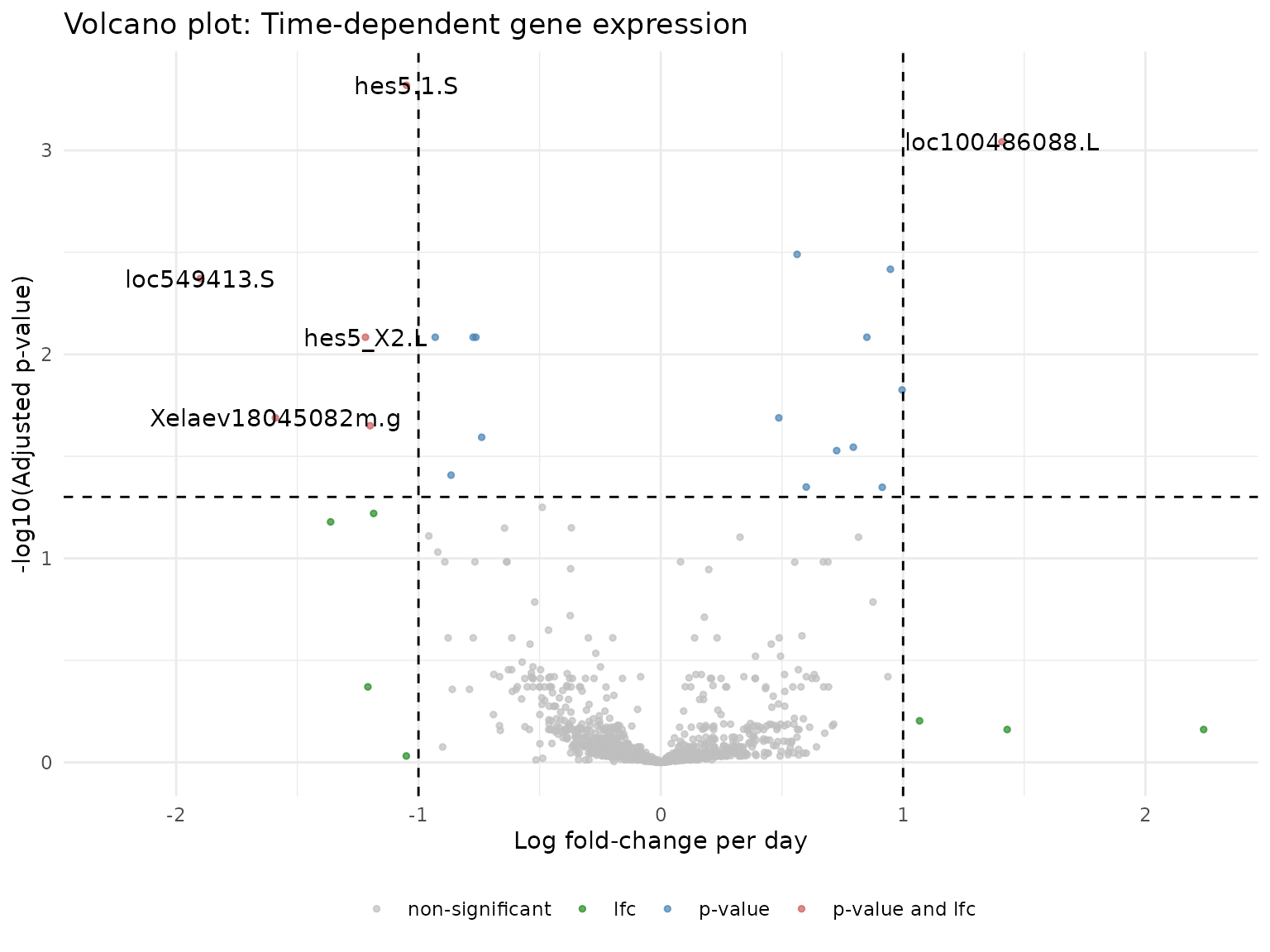
Volcano Plot
Visualize the relationship between effect size (log fold-change per day) and significance:
devil:::plot_volcano(devil.res = de_res) +
  labs(
    title = "Volcano plot: Time-dependent gene expression",
    x = "Log fold-change per day",
    y = "-log10(Adjusted p-value)"
  )
Visualizing Top DE Genes
Identify Top Genes
Select the 10 genes with the strongest time-dependent effects:
top_genes <- de_res %>%
  dplyr::filter(adj_pval <= 0.05) %>%
  dplyr::arrange(desc(abs(lfc))) %>%
  dplyr::slice_head(n = 10) %>%
  dplyr::pull(name)

cat("Top 10 time-responsive genes:\n")
#> Top 10 time-responsive genes:
print(top_genes)
#>  [1] "loc549413.S"       "Xelaev18045082m.g" "loc100486088.L"
#>  [4] "hes5_X2.L"         "Xetrov90029035m.L" "hes5.1.S"
#>  [7] "Xelaev18007618m.g" "loc100492943.L"    "hoxa13.L"
#> [10] "Xelaev18025819m.g"

# Show their statistics
de_res %>%
  dplyr::filter(name %in% top_genes) %>%
  dplyr::select(name, lfc, pval, adj_pval) %>%
  dplyr::arrange(desc(abs(lfc))) %>%
  print()
#> # A tibble: 10 × 4
#>    name                 lfc        pval adj_pval
#>    <chr>              <dbl>       <dbl>    <dbl>
#>  1 loc549413.S       -1.90  0.0000106   0.00425
#>  2 Xelaev18045082m.g -1.59  0.000133    0.0205
#>  3 loc100486088.L     1.41  0.000000909 0.000909
#>  4 hes5_X2.L         -1.22  0.0000333   0.00824
#>  5 Xetrov90029035m.L -1.20  0.000157    0.0224
#>  6 hes5.1.S          -1.05  0.000000240 0.000480
#>  7 Xelaev18007618m.g  0.996 0.0000822   0.0149
#>  8 loc100492943.L     0.948 0.00000765  0.00383
#>  9 hoxa13.L          -0.931 0.0000281   0.00824
#> 10 Xelaev18025819m.g  0.914 0.000448    0.0448
Expression Trajectories Over Time
Create scatter plots showing how expression changes with days post-amputation for top genes:
counts <- assay(sce_sub, "counts")

# Function to plot gene expression vs. DaysPostAmputation
plot_gene_trajectory <- function(gene_name) {
  stopifnot(gene_name %in% rownames(counts))

  # Get gene info
  gene_info <- de_res %>% dplyr::filter(name == gene_name)

  df <- tibble(
    DaysPostAmputation = as.numeric(as.character(sce_sub$DaysPostAmputation)),
    expr = as.numeric(counts[gene_name, ])
  )

  # Create plot
  p <- ggplot(df, aes(x = DaysPostAmputation, y = log1p(expr))) +
    geom_point(
      alpha = 0.3,
      size = 1.5,
      position = position_jitter(width = 0.08, height = 0),
      color = "gray40"
    ) +
    stat_summary(
      fun = mean,
      geom = "point",
      size = 2.8,
      color = "red"
    ) +
    theme_bw() +
    labs(
      title = gene_name,
      subtitle = sprintf(
        "LFC/day = %.3f, adj. p = %.2e",
        gene_info$lfc,
        gene_info$adj_pval
      ),
      x = "Days post amputation",
      y = "log1p(Counts)"
    ) +
    theme(plot.subtitle = element_text(size = 9))

  return(p)
}
Plot Top Upregulated and Downregulated Genes
# Get top upregulated and downregulated genes
top_up <- de_res %>%
  dplyr::filter(adj_pval < 0.05, lfc > 0) %>%
  dplyr::arrange(desc(lfc)) %>%
  dplyr::slice_head(n = 2) %>%
  dplyr::pull(name)

top_down <- de_res %>%
  dplyr::filter(adj_pval < 0.05, lfc < 0) %>%
  dplyr::arrange(lfc) %>%
  dplyr::slice_head(n = 2) %>%
  dplyr::pull(name)

# Create plots
plots <- lapply(c(top_up, top_down), plot_gene_trajectory)

# Arrange plots
ggpubr::ggarrange(
  plotlist = plots,
  ncol = 2,
  nrow = 2,
  align = "hv"
)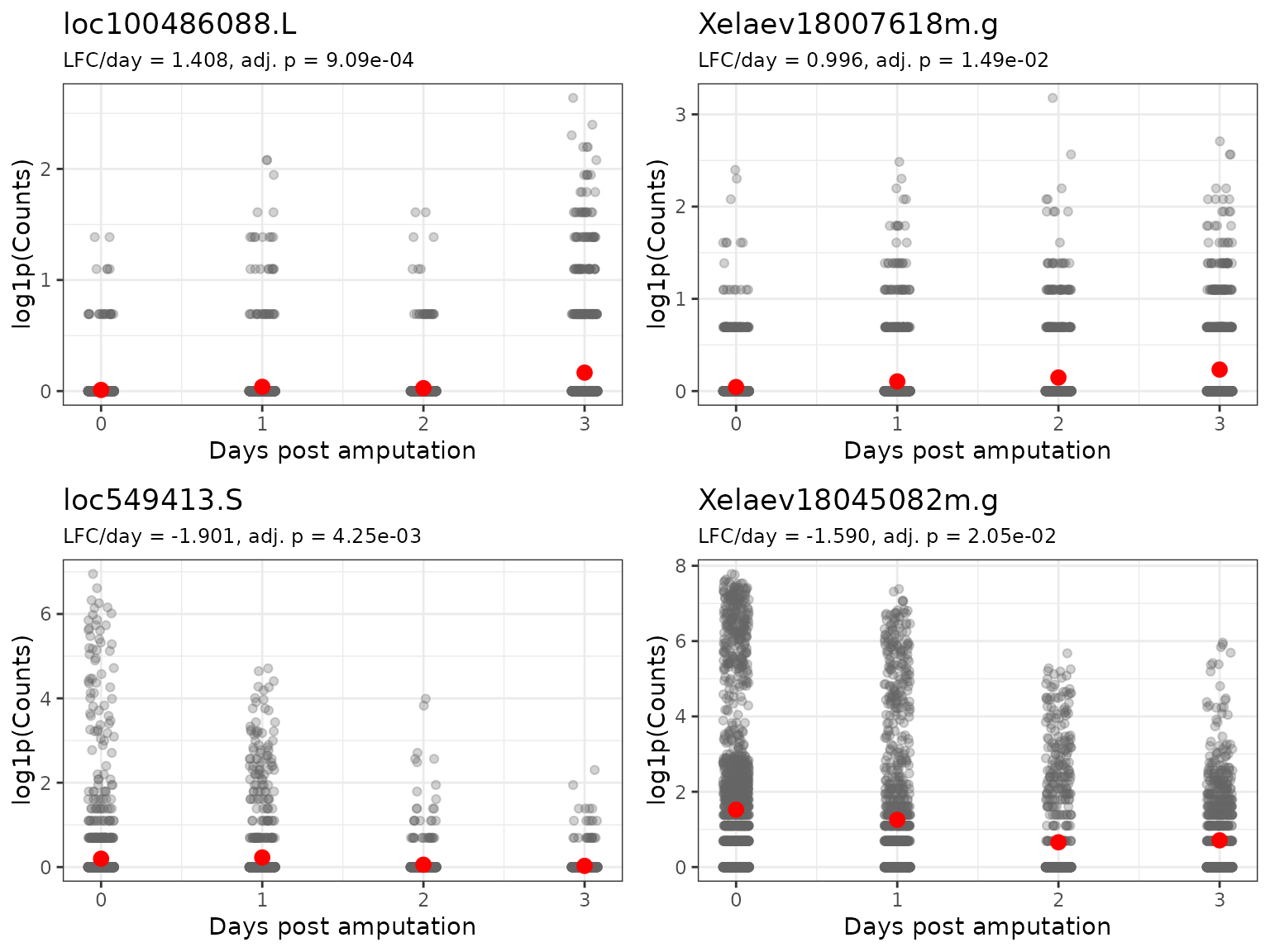
Interpretation:
- Each point represents a single cell
- The red point indicates the mean expression for a given day
Summary
This vignette demonstrated:
- Data preparation: Filtering and structuring single-cell RNA-seq data
- Design matrix: Creating a model with continuous covariates
-
Model fitting: Using
fit_devil()to estimate gene-specific parameters - Hypothesis testing: Identifying genes with significant time-dependent expression
- Visualization: Interpreting results through volcano plots and expression trajectories
sessionInfo()
#> R version 4.6.1 (2026-06-24)
#> Platform: x86_64-pc-linux-gnu
#> Running under: Ubuntu 24.04.4 LTS
#>
#> Matrix products: default
#> BLAS:   /usr/lib/x86_64-linux-gnu/openblas-pthread/libblas.so.3
#> LAPACK: /usr/lib/x86_64-linux-gnu/openblas-pthread/libopenblasp-r0.3.26.so;  LAPACK version 3.12.0
#>
#> locale:
#>  [1] LC_CTYPE=C.UTF-8       LC_NUMERIC=C           LC_TIME=C.UTF-8
#>  [4] LC_COLLATE=C.UTF-8     LC_MONETARY=C.UTF-8    LC_MESSAGES=C.UTF-8
#>  [7] LC_PAPER=C.UTF-8       LC_NAME=C              LC_ADDRESS=C
#> [10] LC_TELEPHONE=C         LC_MEASUREMENT=C.UTF-8 LC_IDENTIFICATION=C
#>
#> time zone: UTC
#> tzcode source: system (glibc)
#>
#> attached base packages:
#> [1] stats4    stats     graphics  grDevices utils     datasets  methods
#> [8] base
#>
#> other attached packages:
#>  [1] ggpubr_0.6.3                tidyr_1.3.2
#>  [3] ggplot2_4.0.3               dplyr_1.2.1
#>  [5] Matrix_1.7-5                scRNAseq_2.26.0
#>  [7] SingleCellExperiment_1.34.0 SummarizedExperiment_1.42.0
#>  [9] Biobase_2.72.0              GenomicRanges_1.64.0
#> [11] Seqinfo_1.2.0               IRanges_2.46.0
#> [13] S4Vectors_0.50.1            BiocGenerics_0.58.1
#> [15] generics_0.1.4              MatrixGenerics_1.24.0
#> [17] matrixStats_1.5.0           devil_0.99.0
#>
#> loaded via a namespace (and not attached):
#>   [1] RColorBrewer_1.1-3        jsonlite_2.0.0
#>   [3] magrittr_2.0.5            GenomicFeatures_1.64.0
#>   [5] gypsum_1.8.0              farver_2.1.2
#>   [7] rmarkdown_2.31            fs_2.1.0
#>   [9] BiocIO_1.22.0             ragg_1.5.2
#>  [11] vctrs_0.7.3               memoise_2.0.1
#>  [13] Rsamtools_2.28.0          DelayedMatrixStats_1.34.0
#>  [15] RCurl_1.98-1.19           rstatix_0.7.3
#>  [17] htmltools_0.5.9           S4Arrays_1.12.0
#>  [19] AnnotationHub_4.2.1       curl_7.1.0
#>  [21] broom_1.0.13              Rhdf5lib_2.0.0
#>  [23] SparseArray_1.12.2        Formula_1.2-5
#>  [25] rhdf5_2.56.0              sass_0.4.10
#>  [27] alabaster.base_1.12.0     bslib_0.11.0
#>  [29] desc_1.4.3                alabaster.sce_1.12.0
#>  [31] httr2_1.2.3               cachem_1.1.0
#>  [33] GenomicAlignments_1.48.0  lifecycle_1.0.5
#>  [35] pkgconfig_2.0.3           R6_2.6.1
#>  [37] fastmap_1.2.0             digest_0.6.39
#>  [39] AnnotationDbi_1.74.0      ExperimentHub_3.2.0
#>  [41] textshaping_1.0.5         RSQLite_3.53.3
#>  [43] labeling_0.4.3            filelock_1.0.3
#>  [45] httr_1.4.8                abind_1.4-8
#>  [47] compiler_4.6.1            bit64_4.8.2
#>  [49] withr_3.0.3               S7_0.2.2
#>  [51] backports_1.5.1           BiocParallel_1.46.0
#>  [53] carData_3.0-6             DBI_1.3.0
#>  [55] HDF5Array_1.40.0          alabaster.ranges_1.12.0
#>  [57] alabaster.schemas_1.12.0  ggsignif_0.6.4
#>  [59] rappdirs_0.3.4            DelayedArray_0.38.2
#>  [61] rjson_0.2.23              tools_4.6.1
#>  [63] otel_0.2.0                glue_1.8.1
#>  [65] h5mread_1.4.0             restfulr_0.0.17
#>  [67] rhdf5filters_1.24.0       grid_4.6.1
#>  [69] gtable_0.3.6              ensembldb_2.36.1
#>  [71] utf8_1.2.6                car_3.1-5
#>  [73] XVector_0.52.0            BiocVersion_3.23.1
#>  [75] pillar_1.11.1             BiocFileCache_3.2.0
#>  [77] lattice_0.22-9            rtracklayer_1.72.0
#>  [79] bit_4.6.0                 tidyselect_1.2.1
#>  [81] Biostrings_2.80.1         knitr_1.51
#>  [83] ProtGenerics_1.44.0       xfun_0.59
#>  [85] UCSC.utils_1.8.0          lazyeval_0.2.3
#>  [87] yaml_2.3.12               evaluate_1.0.5
#>  [89] codetools_0.2-20          cigarillo_1.2.0
#>  [91] tibble_3.3.1              alabaster.matrix_1.12.0
#>  [93] BiocManager_1.30.27       cli_3.6.6
#>  [95] systemfonts_1.3.2         jquerylib_0.1.4
#>  [97] Rcpp_1.1.1-1.1            GenomeInfoDb_1.48.0
#>  [99] dbplyr_2.6.0              png_0.1-9
#> [101] XML_3.99-0.23             parallel_4.6.1
#> [103] pkgdown_2.2.0             blob_1.3.0
#> [105] AnnotationFilter_1.36.0   sparseMatrixStats_1.24.0
#> [107] bitops_1.0-9              alabaster.se_1.12.0
#> [109] scales_1.4.0              purrr_1.2.2
#> [111] crayon_1.5.3              rlang_1.2.0
#> [113] cowplot_1.2.0             KEGGREST_1.52.2